How the "floor of zero" works, and what it costs you
In a fixed indexed annuity, the "floor of zero" means this: in a year the market index falls, your account is credited 0% interest; the index loss does not come out of your account value. The cost of that floor is the other half of the deal: in years the index rises, you receive only part of the gain. Neither half makes sense without the other.
The mechanism, step by step
A fixed indexed annuity is an insurance contract, not a market account. Your money is not invested in the index. Instead, the insurance company watches an index (often the S&P 500) over a set period, usually one year, and uses its movement to figure the interest you're credited.
Three things follow from that design. First, if the index ends the period down (5%, 20%, any amount), your credited interest for that period is zero, and your account value does not drop with the index. Second, interest already credited in earlier periods stays in the account; most contracts "reset" annually, so a past gain doesn't get taken back by a later bad year. Third, the protection is only as solid as the insurance company behind it, since it depends on the company's ability to pay its claims. That's why how to check a carrier's financial strength is worth ten minutes of your time. An FIA is not a bank product and is not FDIC insured.
What the floor costs you
Insurance companies are not charities. The floor is paid for with limits on your upside, usually one of three ways. A cap sets the most you can be credited: with a 7% cap, a 12% index year credits you 7%. A participation rate gives you a share of the gain: at 50%, a 10% index year credits 5%. A spread subtracts a percentage first: with a 3% spread, an 8% year credits 5%. (All examples only, not current rates, not an offer.) Companies can usually adjust these at renewal within limits the contract states.
A cap
- 12%
- 7%
- You get
- 7%
A participation rate
- 10%
- 50%
- Credits
- 5%
A spread
- 8%
- − 3%
- Credits
- 5%
So in a strong market decade, an FIA captures some of the growth, not most of it. If someone pitches you "market upside with none of the downside," they are leaving out half the contract. The honest framing is a trade: you give up big up-years to remove down-years.
What the floor does not do
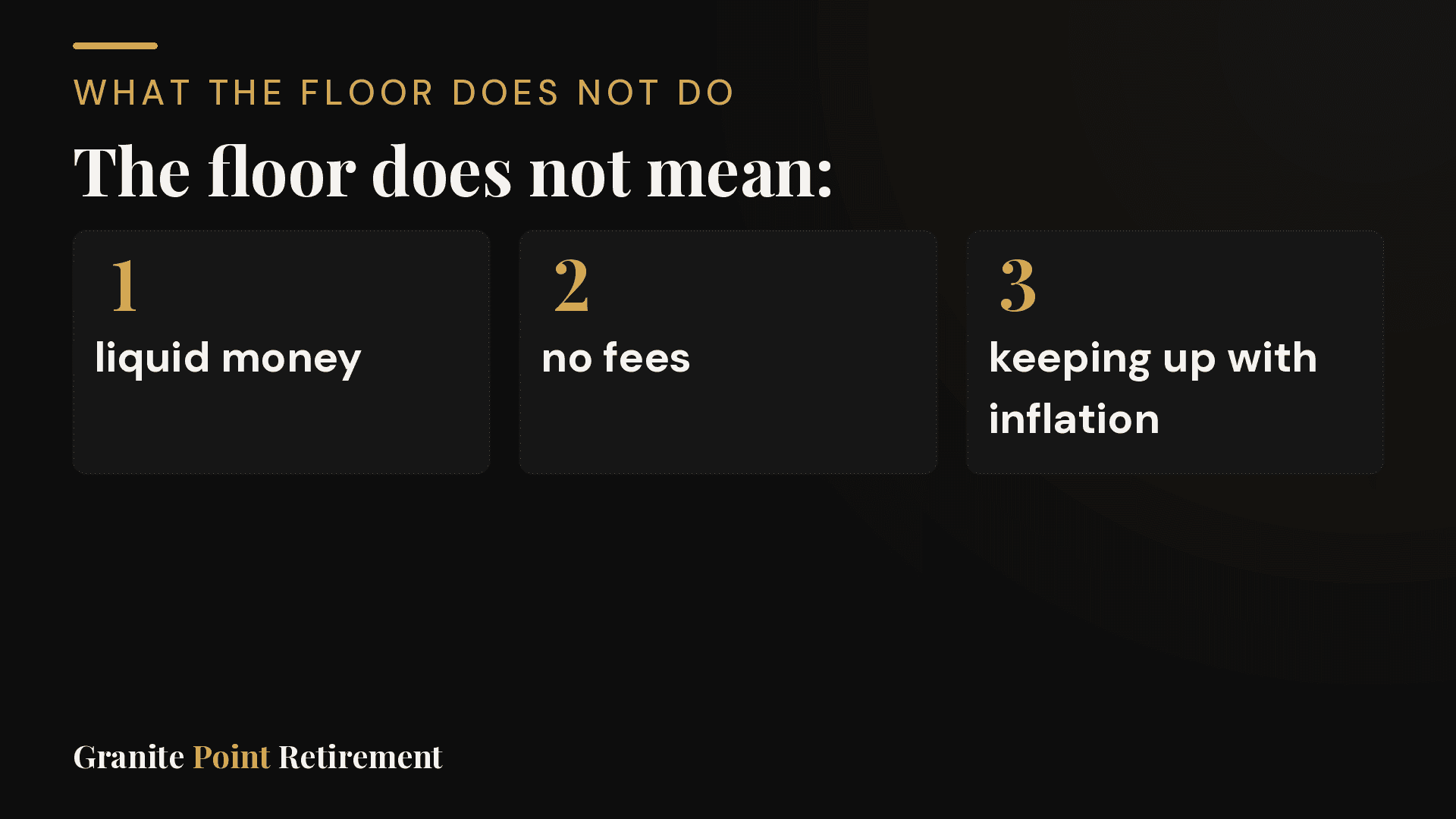
It does not make the money liquid. Surrender charges typically apply to early withdrawals beyond the allowed amount for the first 7 to 10 years. It does not remove rider fees, where a rider is chosen; those come out regardless of index performance. And it does not protect purchasing power by itself: a string of 0% years is still a string of years inflation ran and your money didn't.
Who this trade tends to suit
The floor matters most when a bad market year would change your actual plans, which is why this design shows up in conversations with people within about ten years of retirement, protecting a portion of savings they can commit for several years. It suits far fewer people than the ads suggest. If you want the blunt version of who should walk away, that's the next article: who fixed indexed annuities are NOT for.
The full plain-English explainer (mechanics, tradeoffs, and who it's wrong for) is here: how fixed indexed annuities actually work.
Start your free checkup
Wondering whether this trade fits your situation? That's what the free 1-minute checkup is for: a personalized read, no obligation, and a straight answer either way.
Start my free checkup